An AI logo generator can give you a logo in minutes, but it comes with risks most founders only notice later. You may not be able to own it, it may resemble someone else’s mark, it won’t mean anything specific to your business, and it usually arrives as a single image rather than a logo system. For a business you want to grow, those risks can cost far more than the time you saved.
This isn’t an argument against AI. We use it in the studio every day for research. Read our honest answer to whether AI will replace designers.
1. You may not own it
In the United States, the Copyright Office’s January 2025 report on AI and copyright concluded that material generated purely from text prompts isn’t protected by copyright, because the person writing the prompt doesn’t control how the result is made. Choosing one result from several isn’t enough either.
In practice, a logo generated entirely by AI may be something you can use but can’t stop others from copying. Rules differ between countries and are still changing, so if your logo matters to your business, speak to a trademark or intellectual property lawyer before you build on it.
2. It can look like someone else’s logo
AI tools learn from huge collections of existing images and produce something in between. That’s why the results often feel familiar, and sometimes come uncomfortably close to marks that already exist. You can’t see what a result was based on, and a similar logo in your category can lead to a trademark dispute or a forced rebrand just as your business starts to grow.
3. It looks like everyone else
Branding exists to make you different. When thousands of businesses ask the same tools for “a modern, minimal logo,” they get variations of the same answer: the same gradients, the same shapes, the same safe fonts. A logo that looks average is easy to forget, and being forgettable is expensive.
4. It means nothing
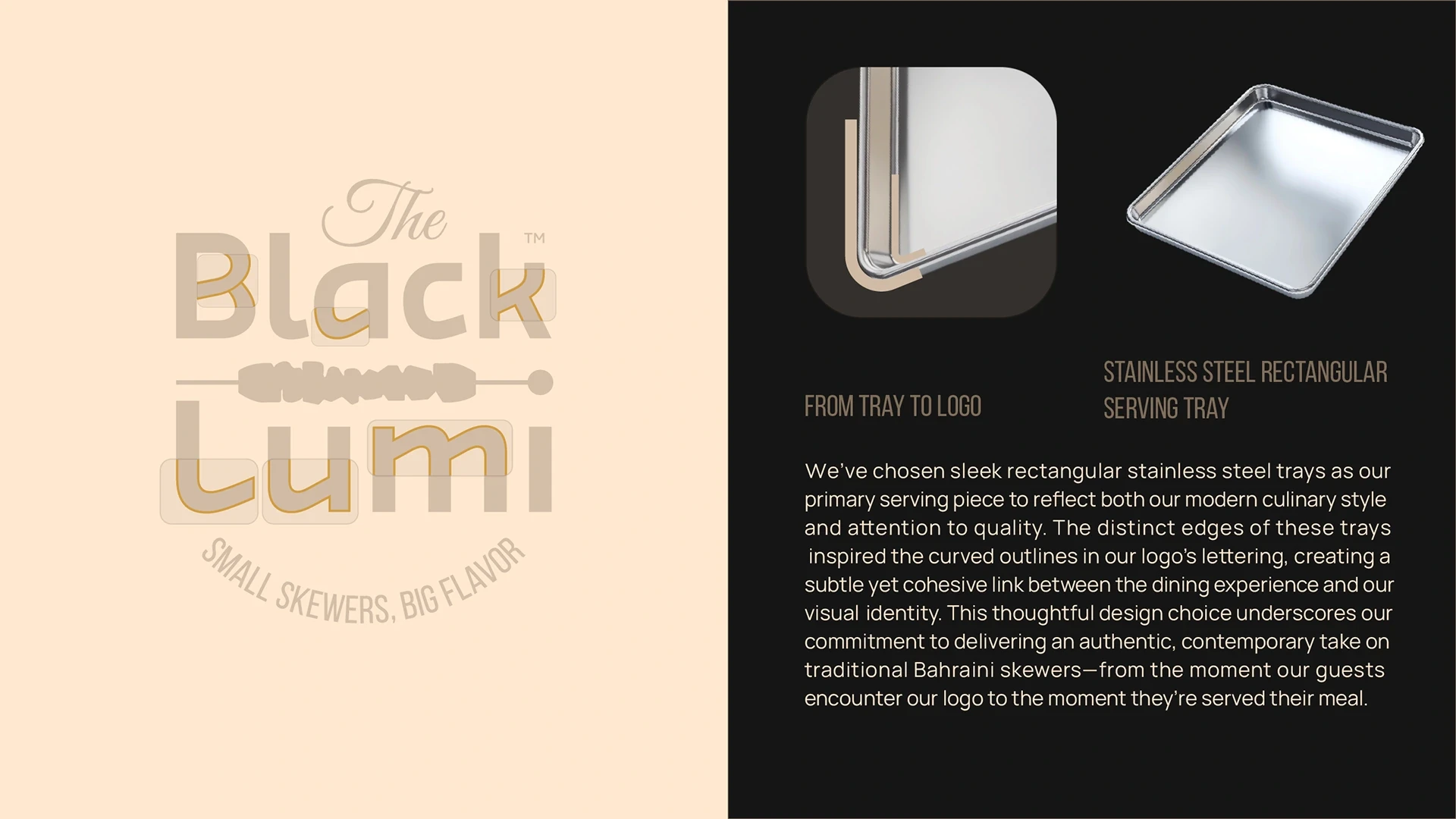
A strong logo carries an idea from inside the business. For The Black Lumi, a London restaurant serving Bahraini skewers, the curved edges of the lettering came from the stainless steel trays the food is served on, and the texture of the letter B was inspired by kebabs. Those details exist because someone studied the restaurant, not because a prompt asked for “a restaurant logo.”
See the full Black Lumi case study.
5. You get an image, not a brand system
Most generators give you one image file. A real identity needs vector files that scale from a sign to an app icon, versions for light and dark backgrounds, a simpler mark for small sizes, exact color values, typography and guidelines that keep everything consistent. Without them, every new use becomes a repair job. Here’s what a complete brand identity includes.
6. People can tell when no one is behind it
People choose brands the way they choose people: they trust the ones that feel real. That’s why so many strong brands now behave more like people, with a point of view, a recognizable voice and details that show someone cared. A generic logo sends the opposite signal, often at the very first moment someone meets your business.
Trust takes a long time to build. If the first thing a customer sees looks like it was put together without thought, they may wonder what else was done the same way.
When is an AI logo good enough?
For a quick test, an internal project, a side project you don’t plan to grow or a sketch to show a designer what you have in mind, an AI logo can be fine. Just treat it as a placeholder, not an asset.
How to use AI safely in your branding
Use AI to research your market, organize your thinking and prepare a clear brief. Then let people turn that thinking into an identity you can own, protect and grow with. That’s how we work: AI supports the research, and every idea, mark and decision is made by people.
Here’s how to brief a branding studio.
Planning a brand you want to last? Tell us about your project, and we’ll build it around the things only your business can say.